

Jobs don’t have to disappearfor work to change.
A lot of the conversation about AI and work still comes down to one question: are jobs going away? I think what's happening is more interesting than that.
Hiring is changing. Skills are changing. Some jobs are paying differently. Companies are redesigning work. And a lot of it is happening before those changes show up in the headline employment numbers.
This is the research and market data I'm reading to understand what's happening.
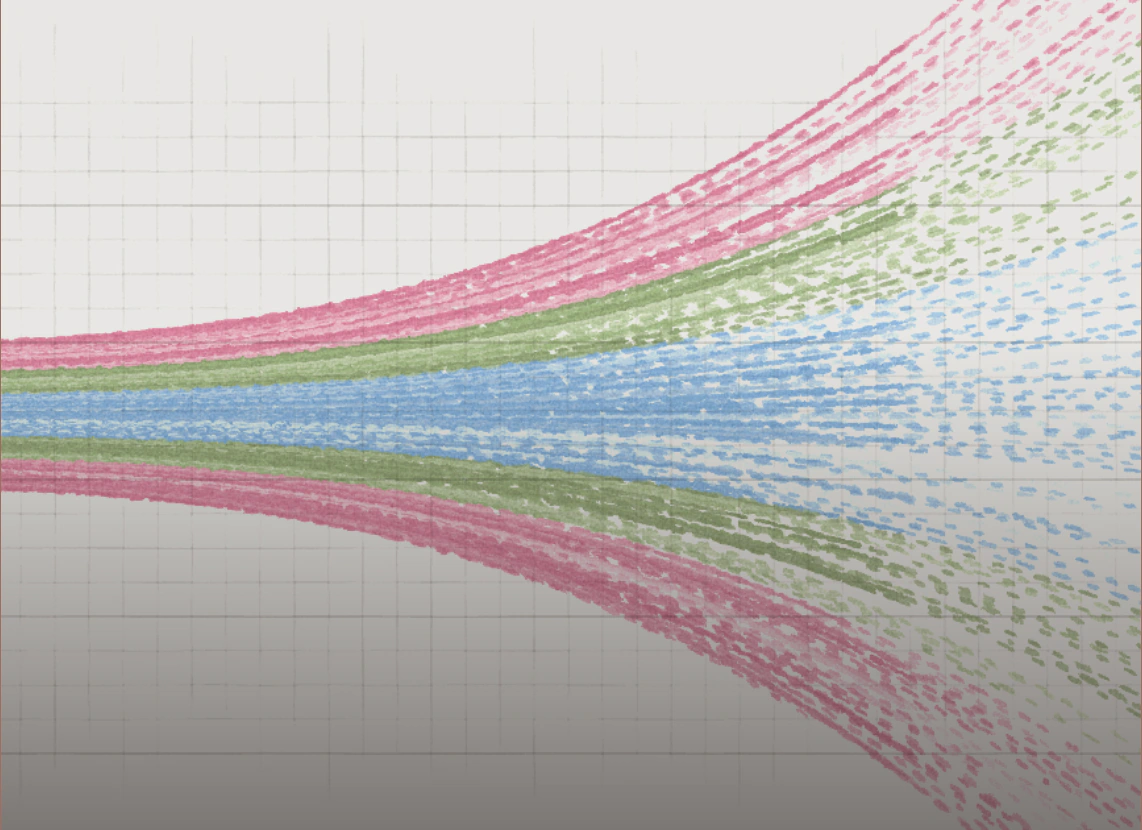
Scenarios for Our Economic Future
Anthropic models three very different economic paths depending on how quickly AI capabilities advance, how broadly they're adopted, how much work is augmented versus automated, whether new tasks are created and how quickly displaced workers can move elsewhere.
This report has me thinking about which assumptions would have to become true for each one to happen.
Anthropic Institute — Scenarios for our Economic Future ↗Roughly the impact the internet had. Real gains, within historical norms, arriving gradually.
AI can perform 50% of knowledge work, but much of that capability stays unadopted. Knowledge worker wages are essentially flat.
>50% of knowledge work automated. Society is far wealthier, but wages fall more than 10% and unemployment rises past recessionary levels.
The entry door may be narrowing before layoffs rise.
Workers ages 22–25 in highly AI exposed occupations are seeing negative impacts, even as Stanford finds no evidence of widespread economy wide AI displacement. It's showing up in the market primarily through reduced hiring rather than increased separations.
Stanford Digital Economy Lab — Canaries in the Coal Mine? ↗Employment gap for workers ages 22–25 in highly AI exposed occupations. The divergence is showing up primarily through hiring.
AI is showing up in pay before employment.
Apollo compared wage and employment trends across 321 U.S. occupations and found that workers in highly AI-exposed jobs have seen slower real wage growth since 2023, while employment in those occupations has remained largely unchanged.
Apollo Global Management — The Impact of AI on the U.S. Labor Market ↗Less real wage growth in highly AI exposed occupations compared with less-exposed occupations since 2023.
Employers are asking for AI skills fast.
By August, U.S. job postings listing AI skills were up 165% from a year earlier. The growth isn't limited to one industry or occupation. Employers are adding AI skills across different kinds of work, which makes this less about a separate category of "AI jobs" and more about what companies are starting to expect inside existing roles.
Bipartisan Policy Center / Lightcast — Navigating Skills Trends ↗year-over-year growth in U.S. job postings listing AI skills.
AI isn't staying in IT.
Among businesses already using AI, Sales and Marketing was the most common place it showed up at 52%, ahead of Strategy and Business Development at 45% and IT at 41%. The spread is real, but it's still fairly concentrated: 57% of adopting firms were using AI in three or fewer business functions.
U.S. Census Bureau — The Microstructure of AI Diffusion ↗of AI-using businesses reported using AI in Sales & Marketing, the most common business function.
The cuts aren't just happening in tech.
Challenger tracked 529,914 announced U.S. job cuts through August. Technology accounted for 29% of them. That means 71% were outside tech, even though technology still led any single industry. The point isn't that AI caused the other 71%. It's that the restructuring happening across the market is much broader than tech.
Challenger, Gray & Christmas — August job cut report ↗of announced U.S. job cuts through August were outside technology.
I organize the research by the question it helps answer.
Adoption numbers can look very different depending on whether we're counting companies, individual workers or employees who happen to work somewhere using AI. I'm more interested in how much AI is actually being used, where it is showing up and whether it's changing the work.
Monitoring AI Adoption in the U.S. Economy
The Fed compares three different measures of adoption and gets three very different answers: about 18% of firms, 41% of workers and 78% of the labor force working at firms that had adopted some AI.
The disagreement is the point. "AI adoption" is not one measure, and it shouldn't be treated as one.
Federal Reserve Board — Monitoring AI Adoption ↗Businesses Are Using AI to Transform Work, Not Cut Jobs
AI use rose sharply among surveyed firms, but the depth of adoption remains much smaller than the headline rate suggests.
The median share of workers actually using AI was 17% at service firms and 7% at manufacturers. Retraining remained more common than layoffs, although some firms reported reducing hiring.
Federal Reserve Bank of New York ↗The strongest current evidence doesn't point to one mass-layoff event. It points to changes at the edges first: fewer openings in some exposed work, narrower entry points for younger workers and different wage outcomes across occupations.
Job Postings Show Early Signs of AI Automation Impact
Using millions of Texas job postings, the Dallas Fed estimates that AI automation exposure was associated with a 2.6% reduction in total postings in 2025, with substantially larger reductions inside more-exposed firms.
Labor demand can weaken without creating a visible layoff wave.
Federal Reserve Bank of Dallas ↗AI doesn't need to eliminate an occupation to change who performs a task, which skills matter, how much judgment is required or what someone becomes responsible for.
Jobs can change before their titles do.
OpenAI analyzed more than 1.5 million work-related ChatGPT messages and found that some of the work people try outside the traditional boundaries of their jobs starts becoming part of their regular workflow. Cross-occupation activity increased 13.1% to 25.9% among workers OpenAI observed consistently from April through July 2026.
OpenAI — How workers are unlocking new ways of working ↗Humans in the Loop
MIT's work with more than 50 companies finds workers shifting from executing some tasks toward supervising them.
The bigger point is that better work isn't an automatic outcome of better AI. Employers still decide whether the technology reduces drudgery, supports learning, preserves expertise or leaves people accountable for work they no longer fully understand.
MIT — Humans in the Loop ↗Usage alone doesn't tell us whether workers feel more secure, more capable or better prepared. The research here looks at trust, anxiety, management, learning and the parts of work that are harder to see in a job count.
Using AI More Does Not Reassure Workers, Managers Do
Frequent AI users were more than twice as likely as occasional users to fear that AI could eliminate their jobs within five years. But the relationship was weaker where workers reported respectful managers and organizations that cared about their wellbeing.
Management is part of the AI transition, not an adjacent issue.
Gallup ↗I'm especially interested in research that gets beyond broad calls for "reskilling" or "responsible AI" and asks what an intervention actually looks like, who owns it and whether there is evidence that it works.
Negotiating Tech
Berkeley's inventory covers more than 950 technology-related provisions across more than 175 collective bargaining agreements.
What makes it useful is how practical the protections are: notice, human review, system testing, access to information, bargaining rights and ways for workers to challenge technology-driven decisions.
UC Berkeley Labor Center ↗Reviewing the Evidence on Worker Retraining
Retraining is one of the most common answers to AI displacement. The evidence is more complicated. A review of 56 randomized U.S. studies finds positive but modest average results: employment rises by roughly two to three percentage points and earnings by about $1,000 annually per person offered training, against an average cost of about $13,000.
A small number of sector-based programs perform much better, but successful replication has been difficult.
That makes the question less "should we retrain people?" and more "which programs actually create durable paths into work?"
Anthropic — Reviewing the evidence on worker retraining ↗I use primary research, public data and transparent methodology wherever I can. I also include industry research when the underlying data is useful, but I label it.
Most importantly, I don't treat AI capability, AI exposure, adoption, observed use, job postings, hiring, employment and wages as interchangeable measures. They answer different questions.
Some of the most useful research right now is showing that those measures are moving at different speeds.